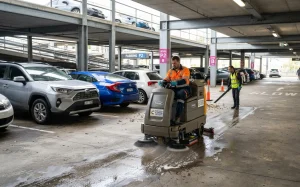
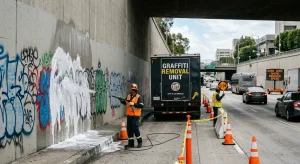
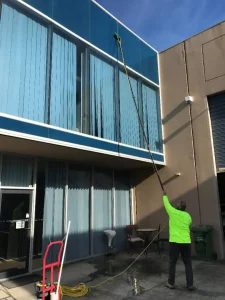
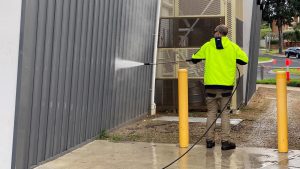
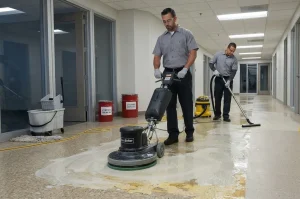
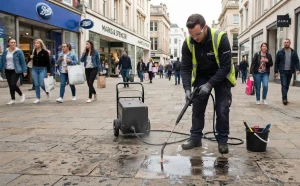
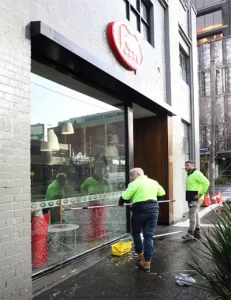
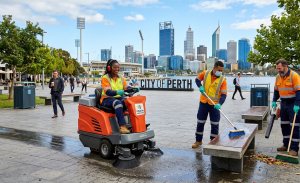
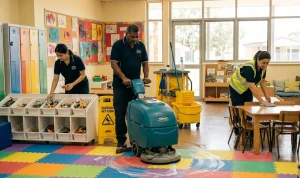
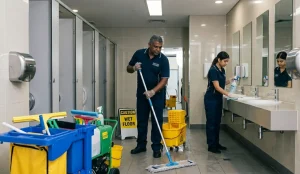
Australian Commercial Maintenance provides traffic-managed commercial cleaning in Victoria for safer access around active worksites and live traffic.
Commercial cleaning or pressure washing becomes more complex when work is scheduled in a car park, loading area, driveway, public-facing facility or roadside environment while vehicles and pedestrians are still moving nearby. For traffic-managed commercial cleaning in Victoria, the key question is not only how the cleaning will be completed, but also who has authority to manage access around the work area. Clear responsibilities can reduce unnecessary interaction between workers, vehicles, pedestrians and cleaning equipment.
Who Controls Access During Commercial Cleaning Near Live Traffic?
Access is generally coordinated by the party with management or control of the site, together with the cleaning contractor and, where required, appropriately qualified traffic-management personnel. Facility or site management may control vehicle entry, loading areas and pedestrian routes, while the cleaning contractor identifies the space needed to position workers and equipment safely.
Responsibilities can overlap when both the client and contractor influence conditions around the work area. WorkSafe Victoria’s temporary traffic management guidance highlights the need to identify and control risks where work occurs on or near roads and public traffic thoroughfares, making early coordination important.
What Changes for Traffic-Managed Commercial Cleaning in Victoria?
When cleaning affects an arterial road, requirements extend beyond an ordinary private-site exclusion zone. In Victoria, works or events on an arterial road must use a Department of Transport and Planning-accredited traffic-management company to design the traffic-management plan and manage traffic on site, with a Memorandum of Authorisation required where temporary traffic-control devices are used to manage traffic through the worksite.
This differs from isolating part of a privately managed car park or loading area under an agreed site arrangement. Cones, signs, flashing beacons and high-visibility clothing can support safety, but they do not by themselves give a cleaning crew authority to stop, redirect or close public traffic.
What Should Facility Managers and Cleaning Contractors Agree Before Work Starts?
Effective traffic-managed commercial cleaning in Victoria depends on planning before crews, vehicles and equipment enter the work area. Facility managers and contractors should confirm traffic conditions, restrictions and responsibilities so commercial cleaning and facility maintenance services can be carried out with appropriate controls and minimal operational disruption.
Key points to agree on include:
- The exact cleaning area and required exclusion zone.
- Whether vehicles, pedestrians or cyclists can continue moving nearby.
- Approved cleaning times and temporary access restrictions.
- Delivery schedules, loading-dock movements and operational traffic.
- Emergency, security and essential vehicle access.
- Responsibility for barriers, signs, traffic controllers or formal traffic-management arrangements where required.
- Safe placement of pressure-washing equipment, hoses and service vehicles.
- Controls for wet surfaces, overspray, debris and wash water.
- Who is authorised to pause work if site conditions change.
Safer Commercial Cleaning Around Live Traffic in Victoria
Well-planned cleaning near live traffic requires more than placing equipment and cones around a work area. Australian Commercial Maintenance provides commercial cleaning and pressure washing for operational sites where access, vehicle movements and site requirements need careful coordination. Choosing an experienced provider for traffic-managed commercial cleaning in Victoria can help facility teams plan cleaning around operational needs and applicable site controls.
Contact us to organise commercial cleaning or pressure washing for busy sites with active vehicle and pedestrian movement.